Showing posts with label Breaking Bad. Show all posts

Thursday, July 30, 2015

That #MrRobot Song You Were Wondering About


With tonight's episode, Mr. Robot is now the natural successor of Breaking Bad.

No kidding.  It's breathtaking.

Some Velvet Morning - Nancy Sinatra and Lee Hazlewood:
Some velvet mornin' when I'm straight
I'm gonna open up your gate
And maybe tell you 'bout Phaedra
And how she gave me life
And how she made it end
Some velvet mornin' when I'm straight

Flowers growing on a hill, dragonflies and daffodils
Learn from us very much, look at us but do not touch
Phaedra is my name

Some velvet mornin' when I'm straight
I'm gonna open up your gate
And maybe tell you 'bout Phaedra
And how she gave me life
And how she made it end
Some velvet mornin' when I'm straight

Flowers are the things we know, secrets are the things we grow
Learn from us very much, look at us but do not touch
Phaedra is my name

Some velvet mornin' when I'm straight
Flowers growing on a hill
I'm gonna open up your gate
dragonflies and daffodils
And maybe tell you 'bout Phaedra
Learn from us very much
And how she gave me life
look at us but do not touch

And how she made it end
Well Eliot does get straight.
And does open up a gate.
And a buncha other things happen too.
Oh my, oh my, yes they do.

Friday, October 04, 2013

Professional Left Podcast #200b -- Final Bonus Breaking Bad Podcast: UPDATE

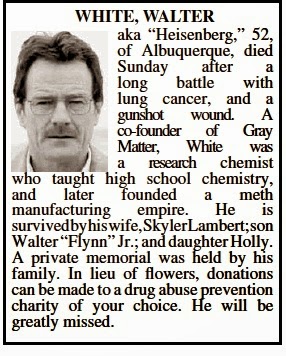
(Walter White, Jr. Obit/Photo courtesy the Albuquerque Journal 
with a big h/t to alert reader David B!)

"The mind is its own place, and in it self
Can make a Heav'n of Hell, a Hell of Heav'n.
What matter where, if I be still the same,
And what I should be, all but less then he
Whom Thunder hath made greater? Here at least
We shall be free..." 

In which we finish our appreciative and recklessly lit'rary speculations about a popular teevee series which now belongs to the ages.

Link to my longer essay on Breaking Bad's final episode, "The Love Song of Walter Hartwell White"


UPDATE:  The "12 Step Program" theme Blue Gal and I riffed heavily on during this podcast and which I blogged about the morning after the broadcast now appears to be less "posh, lit'rary rambling" and more "100% dead-on" now that we have learned the "Salvation Keys" which fell into Walter's lap and triggered his final journey of atonement (the details of which flashed unreadably by during the actual episode) were, in fact, this "Narcotic's Anonymous" key-chain --


-- which reads "Just One Day" on the reverse side and has currently been bid up the $300 at ScreenBid.

So yay for us!

Five years ago I wouldn't have hesitated dropping double that or more for this bit of Breaking Bad history.

Five years later and $300 looks like a small fortune in groceries to me :-)

Funny old world.


"The House Where Nobody Lives" by Tom Waits

There's a house on my block
That's abandoned and cold.
Folks moved out of it
A long time ago.
And they took all their things
And they never came back;
Looks like it's haunted
With the windows all cracked.
And everyone call it
The house,
The house where nobody lives


Once it held laughter,
Once it held dreams.
Did they throw it away?
Did they know what it means?
Did someone's heart break
Or did someone do somebody wrong...


Da' money goes here:


Wednesday, October 02, 2013

The Love Song of Walter Hartwell White


(Caution: There will be spoilers)

Walter White was never a man of the wide and pitiless outdoors.

No, Walter White, Man of Science, was made for careful, synthetic living.  For methodical work done in air-conditioning, preferably with a commanding view of the roasting desert outside.  A man for life in environmentally-controlled comfort -- floating amid the furious struggles of the desert's predators and prey as one in diving bell -- observing the lizards and spiders and junkies and hookers and cacti and meth-heads, but never a part of it.

A man for cool comforts, good whiskey and poolside dinners with family and friends.  A man who might dare to eat a peach, but only if rigorous laboratory protocols are observed.

Walter White was a man raised in the faith of our fathers:  a belief in an orderly society, quietly ruled by the indomitable, bourgeois axioms of the American Dream. And, just like Science, the American Dream promised Walter that the closer he got to a state of perfect understanding and harmony with those axioms, the more respected and prosperous and happy he would be.

Walter White and David Brooks 

would have gotten along famously.

There is no real place for something as hit-or-miss as God in this equation: just chemistry.  Life as a foreseeable, controllable series of orderly, predictable interactions -- white, male, well-educated, urbane, polite plus the right school, the right career, the right marriage, the right family -- that lead to orderly, predictable results.  Work hard enough, and you will do well.  Work hard and be brilliant and the world will shower you with treasure.

And best of all, you are well and truly free to savor your luxuries without a dram of regret or pang of conscience because your faith informs you that you and you alone -- your will, your genius, your superiority -- made all of it manifest.  Your faith makes plain that everyone earns what they get in this life, and gets what they earn, which not only makes material wealth the incontrovertible outward measure of every man's intrinsic value, but also means that charity in any form is the worst and most damnable of all humiliations -- something tainted to be tossed out the back door to life's losers and moochers.

With the rules of the world put in harness to his ambitions, his family would want for nothing.

And the world would remember his name.

Walter White, in other words, was a terribly fragile artifact of our collapsing civilization -- a man not built to withstand the day when all the rules fail him.

And fail him they did.  Spectacularly.  For all his ambition, he ended up in a starter home with a special-needs son and a family he could not support.  For all of his genius, he ended up teaching high school dead-enders and washing cars for an immigrant.  For all of his mastery of science, what he got for his 50th birthday was a telegram from his own body telling him that it was eating itself alive.

And just like that -- bang, bang, bang -- the values Walter's father's generation bequeathed to him turned out to be a scam run by the actual masters of the world:


For the next five seasons, as Walter wanders ever deeper into the wasteland he flings the the same accusation at the Creator of all things over and over again:  "It can't all be for nothing."

Walter White, imploring and wheedling and demanding that a vast, capricious, indifferent Universe of lizards and spiders and junkies and hookers and cacti and meth-heads -- a Universe from which he is no longer partitioned by his status and genius -- better shape the fuck up and get back to exhibiting a moral order that rewards people like Walter White.

But that was never going to happen.

So, like Job, once disaster arrives, Walter White's frame of existential reference as the dutiful servant of the American Dream strands him with no explanation for why the Universe seems to be going out of its way to screw him, while allocating material success to those who are obviously so much less worthy than Walter White.

The Joker didn't create Walter White's world,
 
but he was right there, whispering in Walter's ear when it came apart.
Joker : You have all these rules, and you think they'll save you.

Batman : I have one rule.

Joker : Oh. Then that's the rule you'll have to break to know the truth.

Batman : Which is?

Joker : The only sensible way to live is without rules. And tonight you're gonna break your one rule.

Batman : I'm considering it.
And so, abandoned for no reason in what he believes must surely be Hell -- slowing dying in front of his family, an impotent failure and bankrupt charity-case -- like Lucifer, Walter decides that if no sensible moral order to the Universe exists, he'll damn well create one.  One in which Walter White is the undisputed sovereign.  One mixed and heated and catalyzed into existence by dint of sheer will and the power of his own mind:
The mind is its own place, and in it self
Can make a Heav'n of Hell, a Hell of Heav'n.
What matter where, if I be still the same,
And what I should be, all but less then he
Whom Thunder hath made greater? Here at least
We shall be free; th' Almighty hath not built
Here for his envy, will not drive us hence:
Here we may reign secure, and in my choyce
To reign is worth ambition though in Hell:
Better to reign in Hell, then serve in Heav'n.
This is the merry chase we follow for the next five seasons:  Walter White's quest to extort from the Universe into a moral order which justifies all he has gone through and restores all he has lost.

But what Walter keeps failing to notice is that he is not on quest at all, but a slow descent into a genuine Hell.  A Hell of his own making.  

Walter White, Man of Science, repeatedly failing to notice that the expedients he is using to coerce the Universe into make sense and giving him what he believes he deserves are not the passive tools of his enterprise -- his beakers and burners -- but are the basic ingredients themselves.

In the end, Walter/Heisenberg has failed to learn the basic lesson of Werner Heisenberg: that the idea of a passive observer who can operate outside of the experiment he is conducting without affecting the outcome is an illusion.  And thus is Walter White's experiment in carving out a comprehensible moral order using toxic tools is doomed from the start because no amount of willpower or genius or chem lab discipline can hold him aloof from the chaos his alter ego is unleashing.

Instead Walter find ourselves at the wrong end of a modern variation of Faust -- the brilliant man who makes a pact with the devil thinking that he can use the instruments the devil provides to create a back door in the deal though which he and his family can escape.  And because he has read a book or two, series creator Vince Gilligan knows that all pacts with the devil are cursed. Sure, Walter will be given wealth.  Staggering wealth.  And power. And fame. And even a moral order of his own design.

But it will be wealth he cannot spend.

Fame he cannot claim.

Power which, when exercised, brings only misery to the ones he loves.

And only near the end -- dying alone in a frozen cabin -- will Walter finally realize that he has also succeed at his larger, existential enterprise.  Lie by lie, death by death, Walter White's genius and willpower did indeed impose a kind of moral order on his corner of the Universe: a moral order where his family loathes him and where Nazis can murder his brother in law, steal his fortune and walk away clean.

Walter White, former resident of 308 Negra Arroyo Lane, Albuquerque, New Mexico, now entombed in the ice of Judecca at the bottom of Hades along with all the other betrayers of their lords and benefactors in Dante's Inferno:
‘Vexilla Regis prodeunt inferni, the banners of the King of Hell advance towards us: so look in front of you to see if you discern him,’ said my Master. I seemed to see a tall structure, as a mill, that the wind turns, seems from a distance, when a dense mist breathes, or when night falls in our hemisphere, and I shrank back behind my guide, because of the wind, since there was no other shelter.

I had already come, and with fear I put it into words, where the souls were completely enclosed, and shone through like straw in glass. Some are lying down, some stand upright, one on its head, another on the soles of its feet, another bent head to foot, like a bow.
But Vince Gilligan is a man of mercy and (if the numerous references to them throughout the series are any indication) a believer in 12 Step programs.  So, instead of an eternity of misery frozen into a Hell of his own creation, the moment Walter White finally gives up trying to outwit the Universe and cries out to God to help him make right all that he has ruined, God answers and the keys to Walter's final acts of atonement literally fall into his lap.  

And yes, it is a very strange 12 Step indeed that includes wasting Nazis, poisoning corporate killers and threatening billionaires as part of the program. But in the moral universe Vince Gilligan and his gang of genius writers have created for our entertainment, it all makes perfect sense and a perfect final act to the Tragedy of Walter Hartwell White.

Monday, September 23, 2013

All Hail The King


The wonder is, he hath endur'd so long.

Easily the most famous king in English literature is Lear: a vain and fatally foolish man who wants to enjoy the benefits of imperial pomps and titles,  but doesn't much care for the duties and obligations of actually ruling wisely.

Lear believes he is doing it all for his children, but when it comes time to pass on his legacy and step away from the throne, everything he has built quickly spirals out of control.

His heirs turn on him and on each other.

Eyesight poor and health failing, the half-mad Lear lives long enough the see his legacy in ashes and his ruthless offspring tearing each other apart.

Eventually Lear fless his castle and wanders the wilderness with his Fool.

In the end, nothing that bears his name can escape the disaster her has unleashed and even the most innocent of his children -- the one who had loved her father best and wanted nothing of the chaos he has created -- is sucked in and destroyed by the events Lear has set in motion.

Obviously the analogy breaks down in several places, but it makes for an interesting lens through which to think about "Granite State".

For those of you who do not remember, this is how the king dies.
Lear. Howl, howl, howl, howl! O, you are men of stone.
Had I your tongues and eyes, I'ld use them so
That heaven's vault should crack. She's gone for ever!
I know when one is dead, and when one lives.
She's dead as earth. Lend me a looking glass.
If that her breath will mist or stain the stone,
Why, then she lives.

Earl of Kent. Is this the promis'd end?

Edgar. Or image of that horror?

Duke of Albany. Fall and cease!

Lear. This feather stirs; she lives! If it be so,
It is a chance which does redeem all sorrows
That ever I have felt.

Earl of Kent. O my good master!

Lear. Prithee away!

Edgar. 'Tis noble Kent, your friend.

Lear. A plague upon you, murderers, traitors all!
I might have sav'd her; now she's gone for ever!
Cordelia, Cordelia! stay a little. Ha!
What is't thou say'st, Her voice was ever soft,
Gentle, and low- an excellent thing in woman.
I kill'd the slave that was a-hanging thee.

Captain. 'Tis true, my lords, he did.

Lear. Did I not, fellow?
I have seen the day, with my good biting falchion
I would have made them skip. I am old now,
And these same crosses spoil me. Who are you?
Mine eyes are not o' th' best. I'll tell you straight.

Earl of Kent. If fortune brag of two she lov'd and hated,
One of them we behold.

Lear. This' a dull sight. Are you not Kent?

Earl of Kent. The same-
Your servant Kent. Where is your servant Caius?

Lear. He's a good fellow, I can tell you that.
He'll strike, and quickly too. He's dead and rotten.

Earl of Kent. No, my good lord; I am the very man-

Lear. I'll see that straight.

Earl of Kent. That from your first of difference and decay
Have followed your sad steps.

Lear. You're welcome hither.

Earl of Kent. Nor no man else! All's cheerless, dark, and deadly.
Your eldest daughters have fordone themselves,
And desperately are dead.

Lear. Ay, so I think.

Duke of Albany. He knows not what he says; and vain is it
That we present us to him.

Edgar. Very bootless.

(Enter a Captain.)

Captain. Edmund is dead, my lord.

Duke of Albany. That's but a trifle here.
You lords and noble friends, know our intent.
What comfort to this great decay may come
Shall be applied. For us, we will resign,
During the life of this old Majesty,
To him our absolute power;
[to Edgar and Kent] you to your
rights;
With boot, and such addition as your honours
Have more than merited.- All friends shall taste
The wages of their virtue, and all foes
The cup of their deservings.- O, see, see!

Lear. And my poor fool is hang'd! No, no, no life!
Why should a dog, a horse, a rat, have life,
And thou no breath at all? Thou'lt come no more,
Never, never, never, never, never!
Pray you undo this button. Thank you, sir.
Do you see this? Look on her! look! her lips!
Look there, look there! He dies.

Edgar. He faints! My lord, my lord!

Earl of Kent. Break, heart; I prithee break!

Edgar. Look up, my lord.

Earl of Kent. Vex not his ghost. O, let him pass! He hates him
That would upon the rack of this tough world
Stretch him out longer.

Edgar. He is gone indeed.

Earl of Kent. The wonder is, he hath endur'd so long.
He but usurp'd his life.

Duke of Albany. Bear them from hence. Our present business
Is general woe.

[To Kent and Edgar] Friends of my soul, you
twain
Rule in this realm, and the gor'd state sustain.

Earl of Kent. I have a journey, sir, shortly to go.
My master calls me; I must not say no.
...

Tuesday, September 17, 2013

Here Comes Mr. Lambert


He's from New Hampshire

I wonder if his first name is "Gary"?
"Folie Ă  Deux" is the nineteenth episode of the fifth season of American science fiction television series The X-Files. It was written by Vince Gilligan and directed by Kim Manners. ...
This episode of "The X Files" was about a seemingly normal man who was actually an alien monster who "hides in the light" and preys on those around him, turning them into zombies under his control.

The only one who can see the monster for who and what he really is Mr. Gary Lambert.

Lambert is eventually shot down by the FBI.

Monday, September 16, 2013

Jesse Pinkman Goes To Hell -- UPDATE


So does Walter White.  A different suite perhaps, but Hell is where he lives now.

And Uncle Jack, nephew Todd and their merry band of Nazi's?

They live there; they're on-staff.

Spoiler Alert.

But not really much of a spoiler because you'll get no details you can drive a nail into from me.

I will say that if you've never been in a relationship that went horribly wrong, or were never a part of or lived next door to a dysfunctional family as it flew apart, well, good for you.

There's a point at which the abuser -- berserk with anger -- gropes around for the worst, most awful thing they can say or do.  Words, bats, knives -- it almost doesn't matter. Whatever will inflict maximum pain.  Whatever will make every bridge that might lead back to salvation burn the brightest, that's the bomb which gets thrown.

At this point in the show, almost everyone in Walter White's extended family has an arsenal of such explosives.  And when they start launching them at the people the are supposed to care about, they just can't stop.  Tolstoy might have been right about his characters -- in their Universe, all happy families might be alike and each unhappy family might be unhappy in its own way.  But in the here and now, anyone who has survived an alcoholic parent or spouse will instantly recognize the kind of mindless, lashing, wounded animal (sans actual alcohol) who roared across center stage for much of the last half of "Ozymandias".  The demands for obedience and fidelity from a family he is destroying.  “What the hell is wrong with you? We’re a family!” The frantic belief that if he just shouts loud enough to control the people closest to him one last time everything could be turned around. The son forced to defend his mother against a monster with his father's face.  Children used as leverage.  Cops in the living room.  The pretty suburban house sliced open and its secrets spilled into the street.

Ugly, ugly, ugly.  All ringing with the banal truth of a family trapped by an abuser, and all amped unbearable up by the knowledge that, if pushed, this abuser can summon legions of Nazi executioners.

Walter White is all but gone now.  He lingered awhile, and rallies a little toward the end, but most of what was left of him -- his heart, his head, his soul, his dreams -- is buried in a hole in the desert. Only Heisenberg remains.  Only the Devil.

In The Usual Suspects, 'Verbal' Kint asks, "How do you shoot the devil in the back? What if you miss?"

Breaking Bad answers: "Don't miss."

It goes without saying (except for the fact that such thing should never go without saying) that the writing was uniformly excellent.  The little touches.  The awkwald construction of Walter White's first lie juxtaposed against massive edifice of Heisenberg's last and most monstrous lies collapsing like a veritable House of Usher.  Everyday, bought-em-on-sale-at-Target items like a phone and a set of kitchen knives seen in happier days set against the same phone and the same knives now shining with menace.  A "hideous, crying clown" being boxed up for shipping to someone on eBay fool enough to buy such a thing, and the hideous, crying clown Walter White has at last become, sealed in a crypt of his own making for good and all.  Some players now drained of color, just black and white with a few splashes of beige like makeup on a corpse.  And Heisenberg rolling a Sisyphusian barrel through the wasteland  and right past what looks an awful lot like Walter White's missing pants

from the Breaking Bad pilot.

The two "trunkless legs" of Shelley's poem, abandoned to the desert and forgotten.

Perfect.

Lastly and FWIW, I think the bit at the end where Walter tries to come off like Jimmy Cagney on the phone was a last, desperate piece of impromptu misdirection designed to protect what's left of the family he loves and has ruined. Knowing there must be police on the line, knowing he is about to leave this vale of tears one way or another, Walter finally assigns all the blame where it always belonged -- "I built this.  Nobody else." -- and tries to buy his wife and son out from under his mountain of sin.  And because she is his wife, Skyler picks up on it. Lightening fast, she figures out what her husband is doing and, very tentatively, she replies "Yes, and" to his improv invitation and so begins the tense, encrypted exchange they must now play out in front of both family and John Law.

For-real lastly and, again, FWIW, it was a mistake to watch The Newsroom immediately after watching Breaking Bad. Breaking Bad was always top-notch and is now rocketing up a brilliantly engineered exponential curve unlike anything I have ever seen on teevee, with Vince Gilligan using telescopic flashes of the show's own finale as if it were another lead character, hovering oppresively over the proceedings, imposing its own, grim will.  The Newsroom sucked for awhile, then got better, and is now starting to suck saccharine ass again.

It was like following a six course, gourmet meal with a bag of stale mini-Ding Dongs and weak, church-basement coffee. 

Bad for the dah-gest, as my former grandmother-in-law used to say.

UPDATE:  The outer precincts report in --
Since nobody thought to use "Burned the village to save it" this week, it looks like I have my headline for next week's post.


Friday, September 13, 2013

Professional Left Podcast #197b -- Bonus Breaking Bad Podcast


In which we continue to speculate recklessly about the possible outcome of a popular teevee series which is ticking...down...to...zero...


Da' money goes here: